
Archons and the Shadow Realms: Volume 3
“Exploring Humanity’s Battle with the Unseen

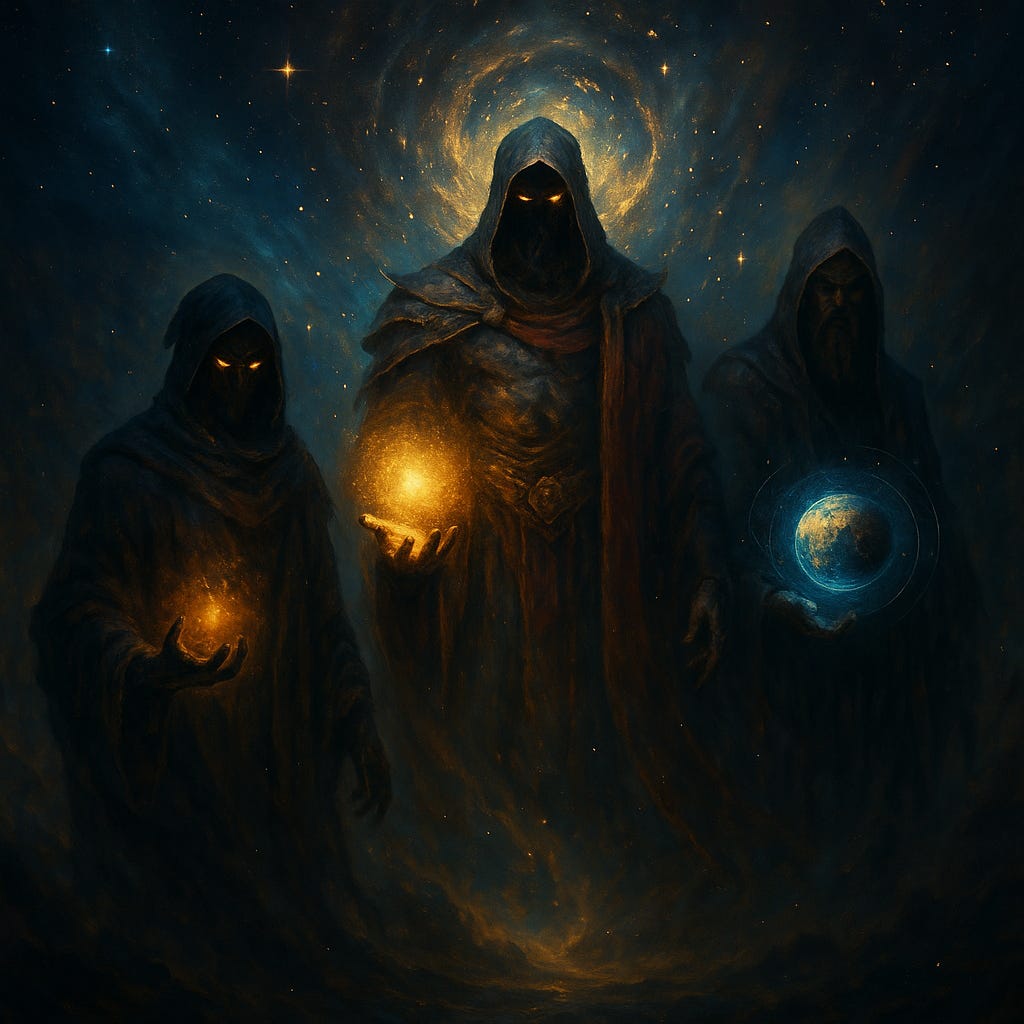
From the earliest myths to the most secretive Gnostic texts, humanity has spoken of hidden forces that operate beyond the veil of ordinary perception. These entities were given many names: demons, spirits, shadow-beings, and in Gnostic cosmology, the Archons. They were described as manipulators of fate, and triumph in the dark, the powers that both govern and distort human destiny. Unlike the gods of light, who were often associated with wisdom, fertility, or cosmic order, the Archons were framed as powers of limitation. They thrived in shadow, restraining humanity from realizing its true potential. Across civilizations, stories of encounters with such entities reveal a striking continuity: a warning that the world we see is not the full reality, and that something unseen pulls the strings.
In this volume, we journey deeper into the realms of these shadow powers. We will trace their presence in ancient myths, from Mesopotamian demons to biblical adversaries, and follow their transformation into the Archons of Gnostic tradition. We will explore their interdimensional nature, their role as wardens of illusion, and the enduring belief that humanity’s struggle is not only physical, but profoundly spiritual, a battle with the unseen.
This is not merely history. It is an inquiry into the forces that still shape the collective psyche, and perhaps, our very future.
The Oldest Shadows: Demons, Chaos, and the Birth of the Adversary
Before the Archons were named in the secret texts of the Gnostics, humanity already carried stories of beings that moved in the darkness between worlds. In the cradle of civilization, Mesopotamia, these entities were not abstract ideas but daily realities. The Sumerians, Akkadians, Babylonians, and Assyrians believed that demons haunted the thresholds of human life: at birth, in illness, in dreams, and in the hour of death.
Mesopotamian Demons and Spirits
The Mesopotamian pantheon included gods of order, but it was equally populated by chaotic forces. Among the most feared were the utukku and edimmu, spirits of the restless dead who tormented the living. The Lamashtu, a female demon, was said to attack pregnant women and infants, feeding on their life force. The figure of Pazuzu, a hybrid being with wings, a scorpion’s tail, and a lion’s face, became one of the most dreaded symbols of malevolent presence.
Yet there was ambiguity. Some demons could be turned against others. Amulets bearing the image of Pazuzu were worn not to summon him, but to ward off Lamashtu. Already in these practices, we see a paradox: humanity tried to fight shadow with shadow, as if acknowledging that the unseen world could only be balanced, never defeated.
The Adversary Archetype
From these myths emerged one of the oldest archetypes: the Adversary. Not simply an enemy in battle, but a cosmic force that opposed order itself. The Mesopotamian chaos-dragon Tiamat, slain by Marduk, embodies this archetype. She represents primordial waters, the endless dark, the source of monsters that resist creation.
When Marduk cleaved her body to form the heavens and the earth, the story was not only about creation, but about control—the violent subduing of chaos. This myth, repeated in countless variations across cultures, suggests that humanity’s very existence was believed to rest on the thin line between order and the shadow that forever sought to consume it.
From Demons to Watchers
These early myths fed into later traditions. The Hebrew Bible absorbed Mesopotamian ideas: the Rephaim, shades of the dead, and the Nephilim, giants born of the Watchers, echo stories of restless spirits and hybrid beings. The Watchers of the Book of Enoch, angels who descended and corrupted humanity, stand as bridges between the divine and the demonic, a theme that would resurface with the Archons.
Here lies a crucial point: the adversaries of humanity were not always external. They were often portrayed as beings who crossed thresholds, mingling with humans, twisting knowledge, and binding the soul to fear. This is the root from which later Gnostic thought would grow: the conviction that powers unseen were not only haunting the edges of life, but actively working to trap humanity in illusion.
Shadows Across Cultures
It is striking that similar patterns appear across the ancient world. In Egypt, demons stalked the underworld and had to be named and overcome by the soul of the deceased. In India, the asuras fought against the gods, vying for cosmic control. In Greece, the daimones were spirits that could inspire or destroy, depending on their nature.
Everywhere, humanity spoke of shadows. And everywhere, those shadows seemed to have the same intent: to limit, to restrain, to confuse. They were not simply monsters. They were wardens. Long before the Gnostics spoke of Archons or early Christians gave form to the Devil, humanity already believed it lived side by side with forces that moved in shadow. In the earliest cities of Mesopotamia, the first urban societies built not only temples and palaces but also rituals of protection. They carved incantations onto clay tablets, buried amulets beneath thresholds, and placed carved demon heads above doorways, not to celebrate these beings, but to ward them off. To live in that ancient world was to accept that the invisible was real, that the unseen could cross into daily life at any moment.
The Mesopotamians named many such forces. The utukku and edimmu were spirits of the restless dead, condemned to wander because their burials had been neglected or because their lives had ended in violence. They were described as clinging to the living, draining vitality and causing disease. One of the most feared female demons was Lamashtu, who was said to prey upon women in childbirth and to feast on infants. In response, the terrifying figure of Pazuzu, a hybrid with wings, claws, a lion’s head, and the tail of a scorpion, was invoked as a defender. Yet this defense was not born of light, but of shadow; one demon was called upon to repel another. Already here we glimpse the paradox of the unseen world: it could not be eradicated, only managed, balanced, and bargained with.
This understanding shaped one of the earliest archetypes that would endure through time: the Adversary. In Mesopotamian myth, the chaos-dragon Tiamat embodied this archetype. She was the endless sea, the primordial waters that resisted order. When Marduk, the champion of the younger gods, split her body to fashion heaven and earth, it was not only a creation story. It was a recognition that existence itself was born from a struggle against chaos, and that chaos was never entirely destroyed. The pieces of Tiamat remained, her essence scattered across the world as a reminder that shadow was always present, always waiting for cracks in the order of things.
This theme is not confined to Mesopotamia. In Egypt, the sun-god Ra sailed through the underworld each night, threatened by the serpent Apophis, who sought to devour the light. Priests and laypeople alike performed rituals to aid Ra in his nightly struggle, for they believed that if he failed, the cosmos itself would collapse into shadow. In India, the stories of the asuras reflect the same eternal tension: divine order constantly under siege by forces of ambition, greed, and deception. In Greece, the daimones could inspire greatness or madness, blessing or destruction. No culture was without these figures. They appear not as monsters from the outside, but as something more intimate, forces woven into the fabric of human existence itself.
The Hebrews inherited these patterns and reframed them in their own narratives. The restless shades of Mesopotamia found echoes in the Rephaim, the spirits of the dead who lingered uneasily in Sheol. The hybrid offspring of the fallen angels in the Book of Enoch, the Nephilim, resembled earlier tales of beings born of divine-human unions, unsettling mixtures that blurred the boundary between heaven and earth. The fallen Watchers, angels who taught forbidden knowledge and corrupted humanity, belong to the same tradition of beings who cross thresholds and entangle humanity in their downfall. Already here we find the seeds of later Gnostic thought: that the true danger lies not in distant gods, but in powers who actively interfere with the human condition, limiting the soul and keeping it bound. What unites all these stories is not simply fear of the unknown. It is the recognition that humanity has always been in a kind of captivity, hemmed in by forces beyond sight. The rituals, incantations, and myths of the ancient world reveal a worldview where survival depended not only on material strength but on spiritual vigilance. The unseen could not be ignored, because it was woven into every stage of life. Birth, illness, dreams, and death, all were portals through which these entities might appear. The very idea of being human was, from the beginning, tied to the struggle with shadow.
And so the line from ancient demons to the Archons of later Gnostic tradition is not a sudden invention but an evolution. The Archons crystallized what earlier myths had always suggested: that there are powers which do not merely attack from the outside, but which govern the very structures of existence. They are jailers as much as they are adversaries, shaping the prison of illusion in which humanity finds itself. The Mesopotamian demons, the Egyptian serpents, the Indian asuras, the Greek daimones, all of them are early faces of the same truth. Humanity has always sensed that beyond the visible world lies a hidden hierarchy, a realm of shadows that seeks to restrain the spirit.
